
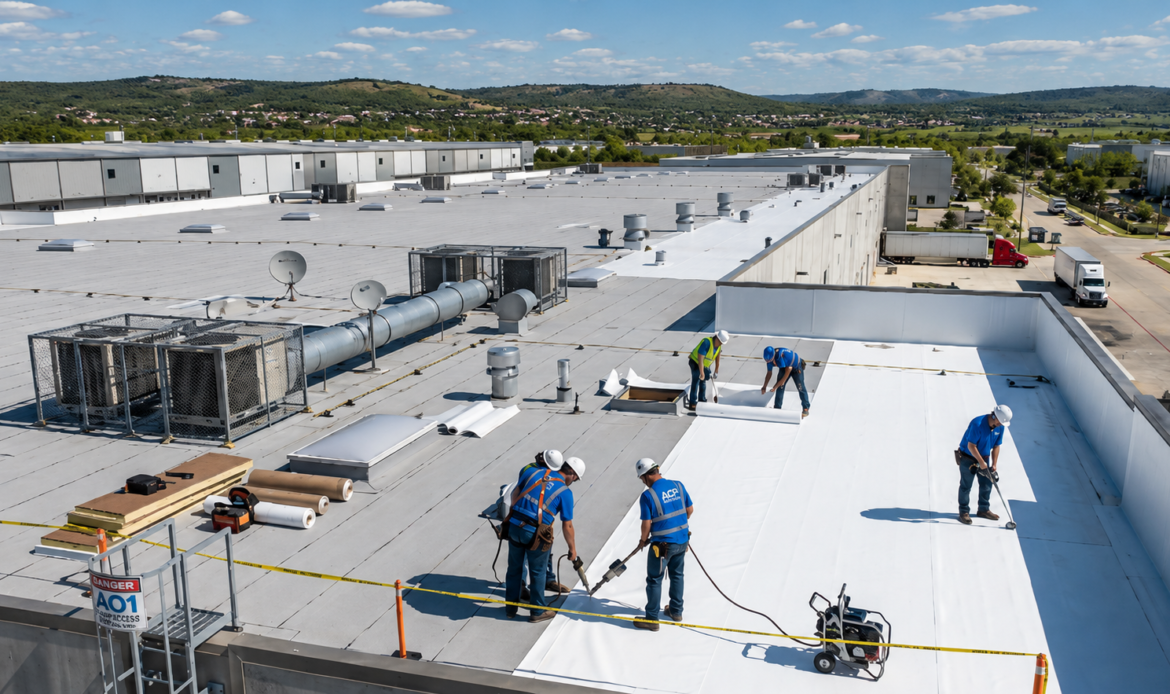
For any business operating in Pasadena, TX, the commercial facility is more than just concrete and steel it is the heartbeat of your entire operation. Whether you manage a busy manufacturing plant near the Houston Ship Channel, a retail center along Beltway 8, an office building near Fairmont Parkway, or a logistics warehouse in neighboring Deer Park, handling a timely commercial roofing repair Pasadena project is the best way to protect your inventory, machinery, and employees. With Southeast Texas seeing massive industrial growth and commercial construction spending reaching historic highs, maintaining your existing physical assets is smarter and more cost-effective than ever. When a leak or structural issue arises, jumping straight into a full roof replacement isn’t always necessary. A targeted repair can extend the lifespan of your current system by years, saving your business tens of thousands of dollars in capital expenditure.
Pasadena’s proximity to the Gulf Coast creates a uniquely punishing environment for commercial properties. Scorching summer temperatures cause roofing membranes to expand rapidly during the day and contract quickly at night, leading to accelerated material fatigue and cracked seams. Heavy coastal downpours frequently cause ponding water on flat and low-slope roofs, which can rot underlying insulation if minor punctures are left unrepaired. Furthermore, high winds can tear at perimeter flashings, loosen metal panels, and lift membrane seams, leaving the building vulnerable to catastrophic water intrusion. Ignoring a small, slow drip in February is a gamble you don’t want to take, as it can easily turn into an emergency that halts your daily business operations entirely during storm season.
When faced with roof damage, the most critical decision is determining whether to repair or replace. A comprehensive commercial roof inspection is the only way to get an accurate assessment, but as a general rule, localized repairs are highly effective if the damage is confined to less than 25% of the total roof area and the underlying insulation remains dry. While a full commercial roof replacement in Texas can easily range from $5 to $15 per square foot (translating to a $70,000+ investment for a standard 10,000 sq. ft. building), a targeted repair focuses only on the failure points. When securing estimates, ensure your contractor checks for trapped moisture beneath the membrane. Patching over wet insulation or rotted decking is a temporary band-aid that will cause the repair to fail, ultimately costing your business double the money down the road. Demand fully itemized quotes that specify material types, labor hours, and structural prep work.
Different commercial structures in Pasadena utilize different roofing materials, and each requires a distinct approach to repairs. For TPO (Thermoplastic Polyolefin) systems, which commonly suffer from punctures or weathered seams, the best approach involves robotic or hand-held heat welding of new TPO patches directly to the cleaned existing membrane. EPDM (rubber) roofs often deal with shrinkage pulling away from parapet walls or adhesive failure at the seams, requiring a specialized primer followed by heavy-duty, self-adhering EPDM cover strips and lap sealants. Metal roofing, particularly standing seam systems, usually faces backed-out fasteners, rusted panels, or failed sealant along flashing profiles. These are fixed by replacing fasteners, applying elastomeric rust-inhibitive coatings, and resealing seams with commercial-grade caulking.
This brings us to the absolute most important regulatory detail for business owners in Harris County: the Texas Department of Insurance (TDI) Windstorm Inspection Program. Portions of Pasadena are designated as catastrophe areas, meaning major structural modifications, alterations, and certain extensive roof repairs require a WPI-8 Certificate of Compliance. If your contractor performs substantial roofing repairs without involving a TDI-appointed inspector or a Texas licensed professional engineer, your property could lose its eligibility for windstorm and hail insurance coverage through the Texas Windstorm Insurance Association (TWIA). Before any work begins, always confirm with your commercial roofing partner that they are fully versed in local windstorm compliance and will handle the coordination with TDI inspectors directly.
To protect your financial investment, don’t sign a repair contract until you ask the contractor key questions regarding their commercial licensing and insurance in Harris County. Confirm whether the scale of the repair requires a WPI-8 certificate and if they will provide a digital report with photos showing the exact cause of the leak before and after the repair. It is also vital to know how they will manage safety and minimize disruptions such as noise, debris, or parking blockages to your daily business operations, and what kind of workmanship warranty they offer on the repaired section.
A commercial roof leak never fixes itself; it only gets more expensive with time. What starts as a minor stain on a ceiling tile can quickly evolve into damaged inventory, ruined electronics, mold growth, and structural rot. Taking a proactive approach to commercial roof repair keeps your overhead low and your business moving forward. Protect your commercial asset today by scheduling a comprehensive, no-obligation commercial roof inspection with AO1 Roofing and Construction.
FREQUENTLY ASKED QUESTIONS
Q1. Will my Pasadena business have to shut down while commercial roof repairs are being made?
No, in the vast majority of cases, your business can remain fully operational. Commercial repair schedules can be structured around your primary operating hours. If the repair requires noisy equipment or creates logistical hurdles, the work can be performed during evenings or weekends to prevent any disruption to your clients and staff.
Q2. How do I know if my commercial roof leak can be repaired, or if it needs a full replacement?
If your roof is relatively new (under 15–20 years old), the leak is isolated to a specific area, and the underlying deck structure hasn’t suffered widespread water damage, a commercial repair is usually the best and most economical choice. However, if more than 25% of the roof is actively failing or water has saturated the insulation boards across the building, a replacement becomes necessary.
Q3. Can you repair a commercial roof while it is actively raining during an emergency?
During an active storm, emergency tarping, sandbags, and temporary specialized sealants designed to adhere in wet conditions can be deployed to mitigate immediate indoor damage. Once the weather clears and the substrate dries completely, the team can return to perform a permanent, code-compliant commercial repair.
Q4. Is assistance available for navigating commercial insurance claims for storm damage?
Yes. If your commercial roof suffered sudden damage from high winds, hail, or flying debris during a recent storm system, full photographic evidence, itemized damage reports, and structural repair estimates can be provided to help you navigate the commercial insurance claims process seamlessly from start to finish.